Showing posts with label Patterning and Algebra. Show all posts

Tuesday, November 26, 2024

Quadratic Card Sort

My grade 10s have been working on quadratic relations and I thought that a good way to help them consolidate all their learning was to give them this card sort. I first saw this years ago in the NCETM's Improving Learning in Mathematics and I made some slight adaptations.


I started by giving the students these two sets of cards:


and they began cutting them out and matching the standard form to the factored form:

Immediately, there were lots of great discussions on factoring, too many almost to track!

When I saw that a group had made the correct matches, I then gave them these cards about the intercepts:

I had debated about whether I should label these with 'x-intercepts' and 'y-intercept' but then thought it would be better for the students to figure out this themselves (which they did!)

When these matches were made, I then gave them the seven graphs (created with the help of Desmos)

Lots of good connections were being made now as students used the factored form and the intercepts to make their decisions. They were then ready for the next set of cards which were the maxima or minima.

These were matched quickly: the graphs helped a lot but I was able to get students to check that each vertex lay halfway between the x-intercepts.
Finally, I gave the cards with the vertex form:

I have not done vertex form with them yet so I was curious as to how they would manage with these. But by using a bit of intuition, they matched the y=(x–5)^2–9 equation with the card that said 'Minimum: (5, -9)' I could then ask groups to expand and simplify the vertex form to see that it matched the standard form of y=x^2+10x+16.
As they beagan to match some of the other vertex form graphs, I could hear some groups making conjectures along the lines of 'Look at the co-ordinates of the vertex, make the x one opposite of what it is but keep the y one the same and then look for that equation.' In doing so, most groups came up with a full set as shown: 

At this point, I was able to get the class to see that when we write an equation in vertex form, it allows us to immediately see the co-ordinates of the vertex which, for some problem solving situations, is important to know. They will learn more about this in the next unit.

Finally, each set of cards purposely had a blank template so I challenged the students to create their own set of cards. I wish I left more time for this though as most groups did not have enough time to complete a full set of cards (a sample is shown below):

If you would like to try this yourself, the cards can be found here.

Wednesday, November 22, 2023

A Visual Approach to Solving Linear Systems by Elimination

I've been lucky enough to work with a teacher of a Grade 10 Applied class and we have been trying to adopt a more visual approach to help students make sense of solving linear systems. We began by challenging students with this puzzle:

The students worked in groups of three on vertical whiteboards and they did a pretty good job of solving this by mainly using a guess-and-check approach. It was interesting that most focussed on the middle two equations first. It allowed me to tell them that we would now learn some cool techniques to solve this pair of equations (i.e. b – c = 5 and b + c = 19). As there were some magnetic algebra tiles handy I then created some zero pairs and asked them what the value of each was:
Now it might seem like an obvious question, but in particular I needed to be sure that they were good with the idea that when they see 3x and -3x (six things), they combine to give 0.
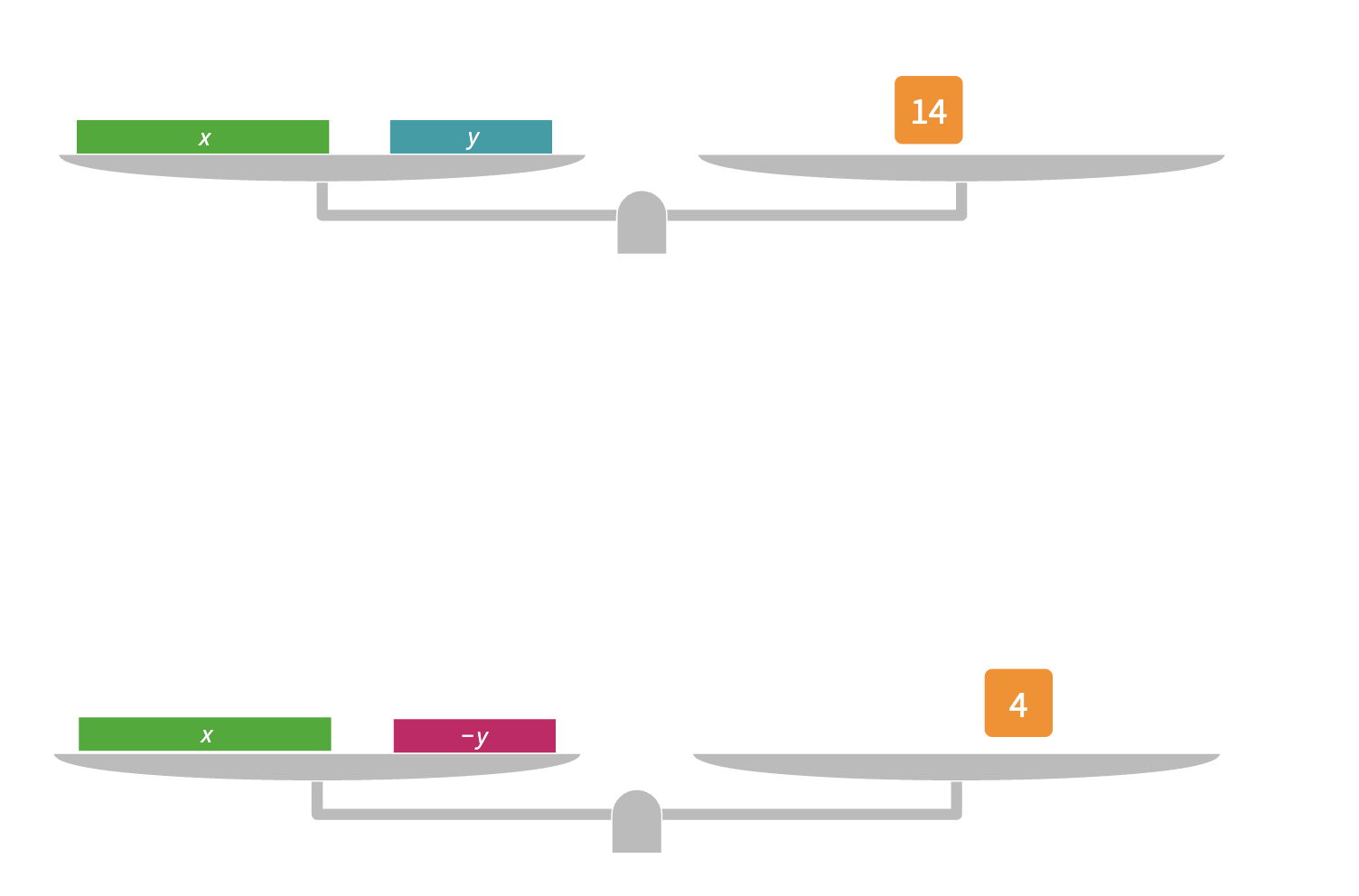
I then used Polypad to show them this linear system:
I asked them to tell me what the two equations were (i.e. x + y = 14 and x – y = 4) and then showed them how we could combine these two equations and, with the power of the zero pair, end up with a simplified equation to solve.

When students saw the y and the -y bars actually be eliminated in front of their eyes, it really did seem to help them make sense of the algebra. What I like about Polypad is that I can show something visually and then alongside it write what is happening symbolically.
The students were then given other linear systems to solve in groups at the whiteboards and we were happy with what they did. Having the students work on the vertical whiteboards allowed us to move from group to group giving feedback when necessary.

This dealt with elimination when one pair of the variables are opposite quantities (e.g. 3y and -3y). But what happens when they are the same quantities (e.g. 4x and 4x)? Well, Polypad can help us again:
Finally, what happens if the linear systems do not have variables in equal or opposite amounts (e.g. 3x + 2y = 16 and x + y = 4)? Well, Polypad allows us to visualise manipulating one of these equations to create a 'match':

When the students reviewed solving linear systems by elimination, it was pleasing to see how well they did:


My thanks go to Ms. K. Perri and her wonderful class of students.
Here are the links to the various Polypads that I have created to help teach this:
Linear Systems 2


Friday, November 25, 2022

Algebraic Expressions and Polypad

I tried this activity in Heather Lyon's MTH1W class using Polypad on Mathigon to help illustrate algebraic expressions. First Q: if this is x + 2 what would 3(x+2) look like? Students go to the VNPS to work in small groups:

Some puzzled looks at first but once they began sketching what it might look like, the students saw what was happening:


I could then easily use Polypad to confirm this:

I followed this up with 5(x+4) and we could now talk of more efficient ways of drawing our thinking. All the while I'm nudging them to the array model:

Now, I want to chunk the ones so give this question. Students' array models are now becoming more efficient:


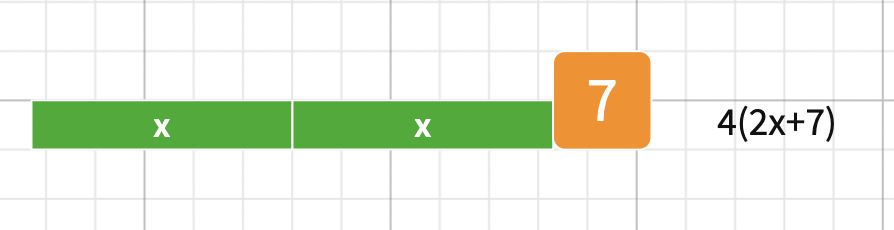
We do this for a few more example. As they are feeling confident, I want to push them so ask them to sketch out what x(2x+3) would look like. Though they have never seen this sort of question before, they connect it to the model that they have just been using:


I can quickly confirm this on Polypad:


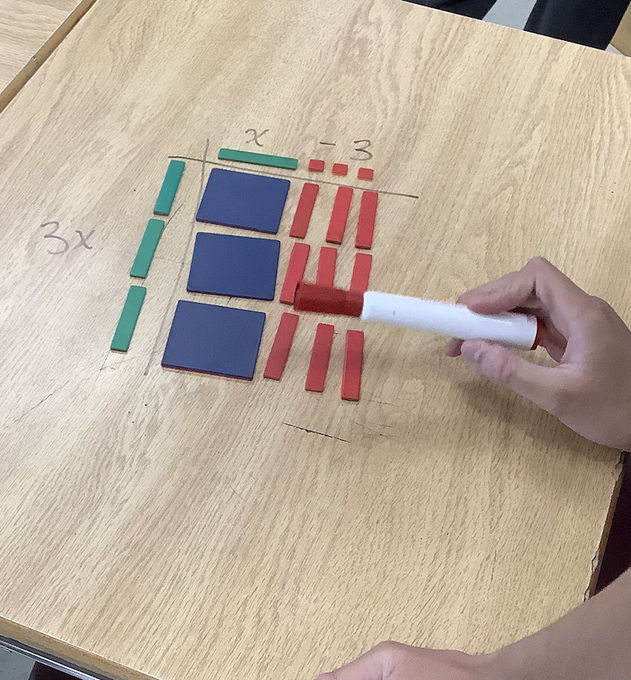
Some students choose to use the concrete algebra tiles but I can then show them how this connects to the diagrammatic model. One of these students says 'Now I see it... and that will save time!'


A few more examples follow and while I help a couple of groups, I give an extension to others: the answer is 18x^2-27 x... what is the question? They factor this successfully without any help from me:


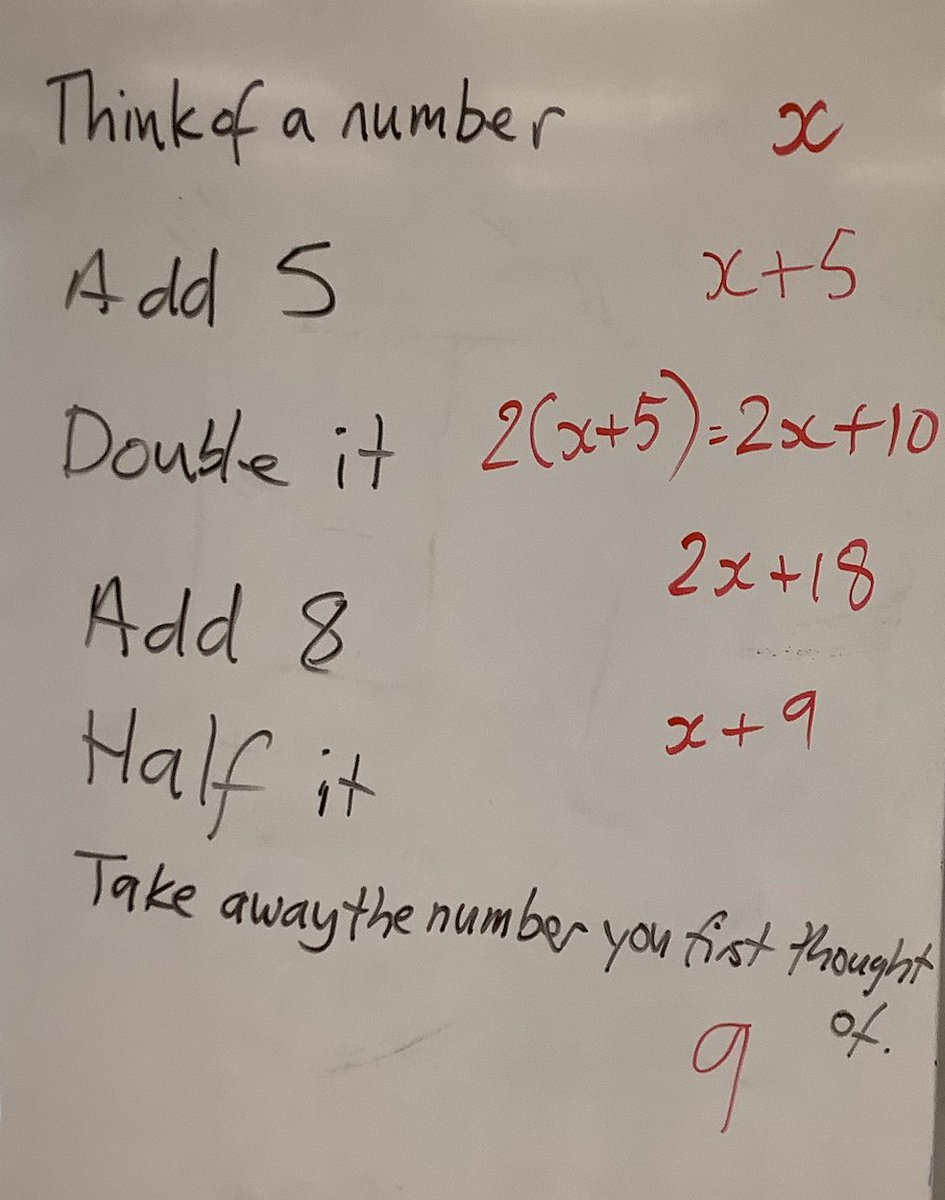
They have been working hard so we take a little break and I perform a little mathmagic: think of a number... add 5, double it... add 8... half it... take away the number you first thought of. By using a little chicanery with a pack of cars, I show them the nine of hearts... the number they were all left with!! I then show how I used algebra to 'rig the system'!


With a little bit of time left, we decide to see if they can use this new knowledge to solve equations. I scroll to the top of my polypad to create an equation from the first two expressions we created:


And with no fuss whatsoever, they successfully solve it!


I was thinking how this approach differed to the one I would have used when I began teaching. Then, I would have given ten examples, no visuals, all symbolic and got the students to do more exercises. Now the students (thanks to Mathigon!) are doing the math!
The link to the polypad I used is here.


Sunday, February 27, 2022

A Nice Algebra Puzzle

Last week I went into a Grade 9 class that had just begun to learn about simplifying polynomials by collecting like terms. I had an idea for a task that I thought would help them with this so began by showing them this pyramid.

I explained that the numbers in two adjacent squares add to give the number in the square directly above them. With this information, I split them into visibly random groups of 3 and had them work at whiteboards to find four numbers that go in the bottom row that would give 54 in the top square.


After completing this, I then gave them this pyramid:


I wanted to see how comfortable they were with collecting like terms before giving them something more thought-provoking. Some were able to complete this symbolically and others were happy to use algebra tiles to help their thinking:


I then gave them this task:

By now, I could hear how adept the students were at collecting like terms and was impressed at the different ways they went about solving the task:


Next, I gave them this task with the restriction that all the terms on the bottom row had to be different:

Again, I was really pleased how they went about solving this (some symbolically, some using algebra tiles again) and by listening to the students talk, I could tell that they were really understanding this. I even overheard a few groups say how much fun the task was!


As this had taken less time than I expected, I had to then think quick and come up with an extension. I asked them that if the value of the top brick was 57, what would the value of the four bottom bricks be?
This required a bit of clarification for two or three groups, but once they understood it, it allowed them to demonstrate their algebraic skills in solving equations and substitution:


It was great to see all the different solutions as well as see that in some cases, the different terms actually resulted in the same value once the substitution was made.

I finished by asking them to figure out:

a) the side lengths of an isosceles triangle, given that the perimeter is 120 cm and that the two equal sides are double the size of the other other side
b) the dimensions of a rectangle given that the perimeter is 1000 cm and that the length is triple the width.

For the first problem, they did this by trial and improvement, so I walked them through how to set this up algebraically. I was pleased to see them al use this approach for the rectangle problem.

I was really happy with the way they remained engaged throughout these tasks, especially as it was a Friday afternoon and would definitely use these again.