Showing posts with label Measurement. Show all posts

Wednesday, March 4, 2020

Elapsed Time and Empty Number Lines

I cannot think of a better tool to help students understand elapsed time than empty number lines. I was in a Grade 4 class and began by asking them to show me various times on their individual analogue clocks. I have blogged before about the importance of making sure (as teachers and parents) that children are familiar with analogue clocks so I was happy to see how adept all these students were with showing me a variety of times. As it was 8:30, I set them a challenge:
What will you be doing in two-and-a-half hours?
As I moved around the class listening to and watching the students thinking, I noticed that some were using the clocks to help them find the new time whilst others seemed to be using their fingers to keep track of their thinking. There were two common answers: 11:00 and 10:00.  
I then told them how I 'see' this problem using an empty number line.
First, I mark the start time on my line:
Then I move forward two hours from this:
And finally add the extra 30 minutes:
One student then said that this was like how they have learned to add and subtract numbers: a good sign!
When we agreed that the time would be 11:00, they were able to tell me that they would just be beginning lunch.
I then gave them this challenge:
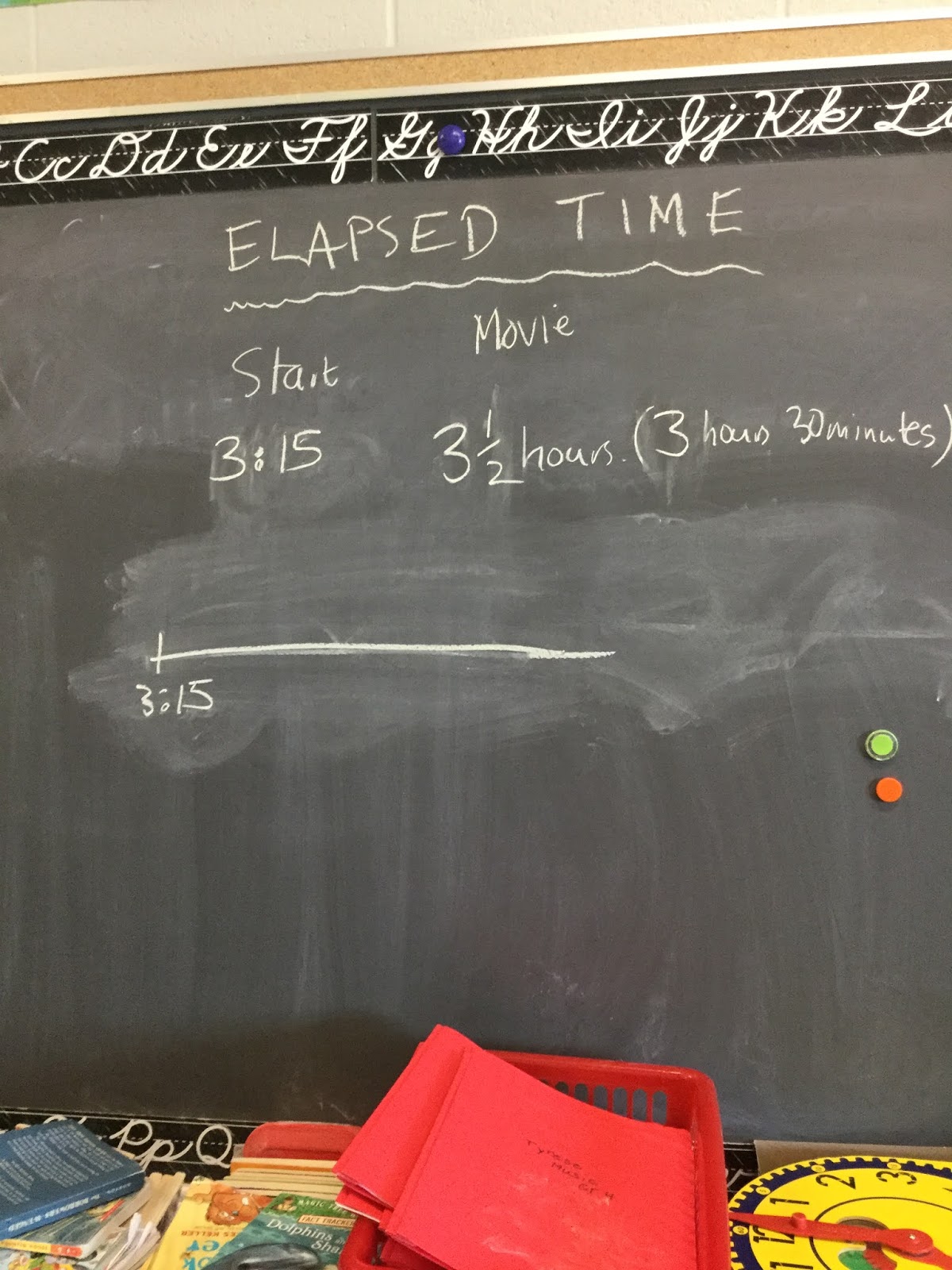
You are going to see a film that starts at 3:15 p.m. You know that it lasts three-and-a-half hours. What time will it finish?

As I moved around the room, I could see students making great progress by using the number line:

Some students used an analogue clock to help their thinking:
All were able to give me the correct time that the film finishes.
My next challenge was this:
Your train leaves Oshawa at 9:15 a.m. and takes 6 hours and 40 minutes to get to its destination. What time will it arrive. Again, the students used the empty number line effectively:

What I like about number lines, is that students use numbers that are friendly them and that these eventually will lead to more efficient strategies such that students (in my experience) begin to 'see' the number line in their head.
I ended the lesson by giving this challenge:
It is now 9:25 a.m. If school ends at 2:50 p.m., how many minutes are there before you go home
Unfortunately, I forgot to take pictures of their solutions, but they were able to get the correct solution despite not being shown how to do problems like this: they just used the empty number line, marked on the start time and end time then figured out the elapsed time in ways like this:


Wednesday, February 12, 2020

Developing Perimeter

I recently was in a grade 3 class and tried this activity with them to help them understand that perimeter is the sum of all the sides of a shape. To help with this, I cut five lengths from stir sticks with these measurements:
3cm, 4cm, 4cm, 5cm, 8cm
I used stir sticks as I wanted something thin so the students focus on the length of the segment and not its width (or even height). I also wanted to see how well these students were meeting the overall expectation: 'estimate, measure and record length, perimeter... using standard units'.
I started by asking the students to order the sticks from shortest to longest:


I then asked them to pick up the longest stick and asked them to estimate how many centimetres it was. I would say that about half the class had a reasonable estimate. To help them refine their answer, I gave them two benchmarks: firstly, that the width of their finger is about a centimetre; and secondly I held up a ruler and showed them what 10cm looked like. This helped all students refine their estimates and was worthwhile doing.
Then, each student was given a ruler and asked to measure and record the lengths of the five sticks. What particularly impressed me with this class was that every student used the ruler correctly i.e. by lining up the zero on the ruler with one end of the stick. It was clear that there teacher has done some fantastic work on this already.
I asked the students to round their  measurements to the closest centimetre (which helped cover the fact that sometimes my cutting was not as accurate as it should have been!)


I then set the students a challenge: 
Create as many triangles as you can using only three sticks and find the perimeter of each triangle.
Before they did this, I demonstrated (using longer sticks) how I wanted them to carefully place the sticks end-to-end.
For the next fifteen minutes, they worked really well on finding as many triangle as possible. I was really impressed as to how much care they took in putting the sticks end-to-end and also how well they recorded their results.


I had carefully chosen the lengths of the sticks to limit the number of possible triangles as well as to create situations where a triangle was impossible. When I realised that they have pretty much found all the possibilities, we recorded our results as a group. As I wrote these down, some students were able to explain why one triangle had the largest perimeter and another had the least perimeter. Some also made the point that some sticks didn't form a triangle so I gave them some time to think about why this was:
This is getting at a big math concept which I think often is not mentioned: the triangle inequality i.e. that two sides of a triangle always sum to more than the third side. Having the sticks in front of them made it easier for me to show them why this is true.
Now some students had earlier tried using four sticks to create a triangle so I gave them one final challenge: 
Create a rectangle with all five sticks and find its perimeter.
Most were able to do this but in the future, I would make it more accessible by asking them to create any shape using all five sticks and to work out its perimeter.
I was really pleased how well the students took to this. It is so important that they have this CONCRETE understanding of what perimeter is before they move on to more diagrammatic and abstract questions and, hopefully, will help them avoid misconceptions as outlined in this earlier post.

Wednesday, November 13, 2019

Unpacking Some EQAO Measurement Questions: Junior

With the recent release of some of the questions used in this year's EQAO Math tests, I thought it might be useful to share some insights as to how students performed on individual questions and what we might learn from these. Here are some measurement questions from the Grade 6 test which raise some concerns (for me at least) regarding how we teach measurement and how we test it.
Concern 1: Counting versus Measuring
As a province, 81% of the students got this correct. It is a classified as a Knowledge question. Initially, we might be encouraged with this, but I wonder if this is really a test of a student's understanding of measurement: maybe they are getting the correct answer simply by counting. As I have written about previously, there is a misconception that some students hold onto when they believe that a measure is discrete and not continuous. This particular question doesn't actually tell me if students really understand volume.

Concern 2: Teaching Conversions
About 70% of the province's students got this correct.
I worry about questions like this as I do not see this as a practical conversion. Who really needs to know how many millimetres a classroom is? Still, it is a better question than this one from a few year's ago:
I have yet to meet any firefighter that knows the length of their truck's ladder in decametres. Now, part of the problem with these questions stem from the specific expectation in the curriculum:
  • select and justify the appropriate metric unit (i.e., millimetre, centimetre, decimetre, metre, decametre, kilometre) to measure length or distance in a given real-life situation
I have a problem with decimetres and decametres being included in the curriculum as there are precious few real-life situations that we actually use these. And fire trucks are not one of those. Nor is using millimetres to measure a classroom. A much better question would be to ask a student to measure a line and write the answer in centimetres and millimetres.
So why are decimetres and decametres included? Maybe it is to 'fill in the gaps' in the metric system but then we fall into the trap of using these mnemonics:
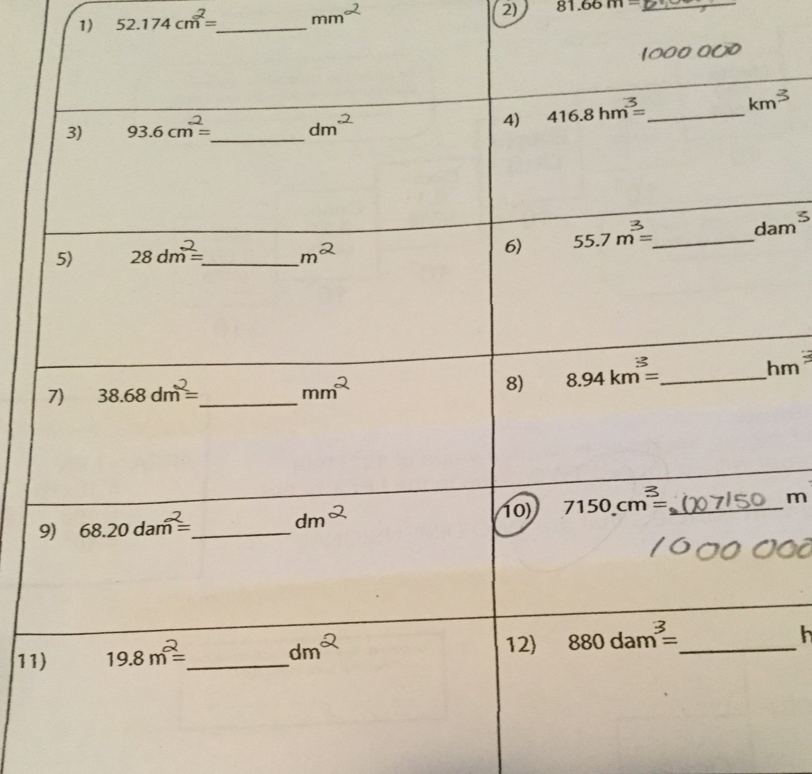
I always cry a little bit when I see something like this: try using it to convert 5 square metres into square centimetres and you'll see why. If we teach conversions this way, we end up with worksheets like this:
Asking students to change from cubic hectometres to cubic kilometres will not improve students' measurement sense. It is much better to get students to physically measure objects using tape measures, scales, measuring containers etc. that have the different units on them (e.g. metres, centimetres, and millimetres marked on a metre stick). We should never teach conversions without giving students plenty of practical experience measuring objects. But it would also be better to ask more practical questions like these from earlier EQAO papers:


Concern 3: Developing Formulas
I have written before (here, here, and here) on the importance of developing formulas with our students. Simply giving a student a formula to memorise is not good enough: Students must be given the opportunity to see why a particular formula works. This will necessarily involve a concrete-diagrammatic-symbolic approach (as outlined in this post).
So when half our students answer this correctly: 
I wonder how many of them actually learned about surface area by using cardboard cereal boxes and physically running their hands over the 6 rectangles present and seeing that there were in fact three pairs of rectangles: front and back; left and right; top and bottom.
Also, how many of our students also had to work with open-topped (and even open-bottomed!) boxes? For surface area, I wouldn't even give the students the formula SA=2(lw+lh+wh): it is much better to get them to see that the surface area is the sum of all the required faces.
Of all the released questions, this was the one that our students were the least successful in: only 37% got it right. 
Why is this? From the responses, we know that the students who chose the second option multiplied the 7 and the 4. Those who chose the triangle simply did 6 times 5. So did these students develop the formula with their teachers or were they just given it? It is too hard to say, but my sense is that those who have developed the formula are more likely to remember it and use it it correctly. But what about those who have developed the formula but in the pressure of the test, forgot it? Grade 6 students are not allowed to have the formulas displayed in the classroom for the test. Grade 9 students, on the other hand, are each provided with an individual formula sheet. I have yet to make sense of EQAO's rationale for this but I wonder how much more successful our students will have been if they developed the formula AND had access to the formula for the test. Also, I wonder if the question is a true reflection of the specific expectation: 

develop the formulas for the area of the parallelogram and the area of the triangle, using the area relationships among rectangles, parallelograms and triangles.

For example, the triangle above is not shown related to its generating 6cm by 5cm rectangle.

To end with, it is not just our students who need to see how formulas are developed. At a Math Café for parents earlier this year, I developed the area of a circle with them:


Afterwards, parents told me that they wished that they had been taught this way when they were at school as opposed to being told simply to memorise a set of formulas.

Wednesday, October 16, 2019

Unpacking Some EQAO Measurement Questions: Primary

With the recent release of some of the questions used in this year's EQAO Math tests, I thought it might be useful to share some insights as to how students performed on individual questions and what we might learn from these. I will start by looking at some measurement questions from the Grade 3 test:

I include both the English and French Immersion versions as there was a difference in the results. In English, 82% of the students were right whilst in French, only 68% were right. The most common wrong answer for the French Immersion students was 'mètre'. When I have shown this to some adults who know a bit of French but not a lot, they have also chosen 'mètre' as they did not know what 'clé' meant but knew that 'maison' meant house so figured that metres would be the best answer. Students are not allowed to use English-French dictionaries in the EQAO tests but I wonder if these French Immersion students would have performed better even if a picture of a house key was included?

Here is another interesting question:
Recent tweets from Steven Strogatz revealed his concern that students do not know about analogue clocks. In this question, 68% of the students were right with French Immersion students slightly higher than their English counterparts (76% to 67%). I wonder if this difference a result of the clock being more frequently used as a tool for developing the language in French Immersion classes. I also wonder if telling the time is best taught not as a separate unit but as an ongoing life skill throughout the day, throughout the year. A simple act of taking 30 seconds to stop the class and get them to look at the clock to tell the time, done five or six times throughout the day could have a massive impact on student learning. I've shared some ideas on why analogue clocks are fantastic tools for developing Mathematical thinking previously in this post. 

This question also reveals a common misconception:
Only 57% of students got this correct. Over a quarter of the students chose 240 minutes. This does not surprise me as I often see a common counting misconception where students are asked to count up (or down) by ones from a start number (bolded) and write:
157, 158, 159, 200
or
300, 259, 258, 257
I call this microwave math as I think it develops from situations such as looking at the decimal clack on a microwave, putting in your food, pressing '3 0 0' then start and, WOW! The next number is 259!
So how to address this misconception? Well, firstly we need to acknowledge it exists and not assume that all students (even if they can tell the time) know that there are 60 minutes in an hour. I have seen some teachers write the number of minutes alongside each hour number on their classroom clock, and then ask questions such as, 'It is two hours to lunch. How many minutes is that?' I have also seen some teachers use a double number line with hours on top and the corresponding minutes below. Such strategies done at frequent intervals throughout the year could go a long way to fixing this common misconception.

A final question which is revealing, is this one:
Here, just less than half the students (49%) got this correct. The most common wrong answer was the top one (one-quarter litre, one-half litre, 1 L, 2 L). I wonder how many of these students misread (or are used to seeing) it as a smallest to greatest question? If so, then at least they were kind of correct! What is more problematic are the students who chose one of the middle two answers. For the second one (chosen by 12% of students), I would assume that they are thinking greatest to smallest as this list has 2 L followed by 1 L. Do these students also think that one-quarter litre and one-half litre are therefore bigger than two litres? For the third option, again assuming that the students are thinking greatest to smallest (on account of 2 L being followed by 1 L), do these students think that one-quarter litre is greater than one-half litre? If so this reminds me of the McDonald's-A&Ws math misconception:
So how do we address this misconception? For students to really understand measurement, they need to spend a lot of time practically measuring things. They MUST experience measuring with rulers, tape measures, scales, or, in this case, by pouring water into containers to see the difference between one litre, one-half litre and one-quarter litre. It is actually a great way to develop fractional understanding too (How many quarter cups of water do you need to fill a full cup?)
One final thought: I wonder if any students were confused by the notation used i.e. 2 litres written as 2 L? I only mention this as I am not sure how often (if ever) I use an upper case L to stand for litres. I either write litres out in full or use a lower case l. 

Thursday, March 1, 2018

Creating Thinking Classrooms (2)

Following on from my previous post, I want to gauge the impact of three of the optimal practices highlighted by Peter Liljedahl's research into creating thinking classrooms:

  • start with good questions
  • use vertical non-permanent surfaces
  • use visible random groups of three
I went into three classes (a Grade 4, a Grade 5, and a Grade 6) and gave the students a variant of the Precious Pentominoes activity. 
The Grade 4s were asked to use two pentominoes to create a symmetrical shape with the largest perimeter:


The Grade 5s were asked to use two pentominoes to create a symmetrical shape and then calculate its cost by working out perimeter multiplied by number of sides. They then had to find the most expensive design:


The Grade 6s were asked to do the standard Precious Pentominoes task and find the most expensive design:


Look carefully and you will notice three different methods that the students have chosen for multiplying!
In terms of the three practices outlined at the start, here is what I noticed:
1) The question (which I gave orally) engaged the students from the get go. Allowing the students to use pentominoes meant that the students had multiple entry points into the problem. And the problem itself allowed the students to use many (if not all) of the Mathematical Processes. In other words, it allowed them to think mathematically.
2) The VNPSs made it much easier for me to see what each group of students was thinking. Occasionally, I noticed that some students were not measuring the perimeter carefully (showing misconceptions highlighted in this post). I was able to quickly address these misconceptions by getting the students to focus on the line segments and not the squares. 
The VNPSs also meant that students felt that students felt more comfortable showing their work in the knowledge that if they made a mistake, then they could erase it. And having the students thinking on their feet (literally!) resulted in great discussion and problem solving: more so than I have seen when students are sat down.
3) The students had no trouble at all working in the random groups. The fact that they were in groups of three meant that I had a manageable number of groups to monitor and also allowed for a good exchange of ideas between the trio. Even students who teachers identified as having difficulties with Math rose to the challenge of the problem. From what I could see, every student made some contribution.

Each of these three practices certainly had an impact in creating a thinking classroom in each of these junior grades (like it did with the intermediate class in my last post). I left each of these classes amazed by the wonderful mathematicians I had just worked with.
Now, how would it look with high school students?