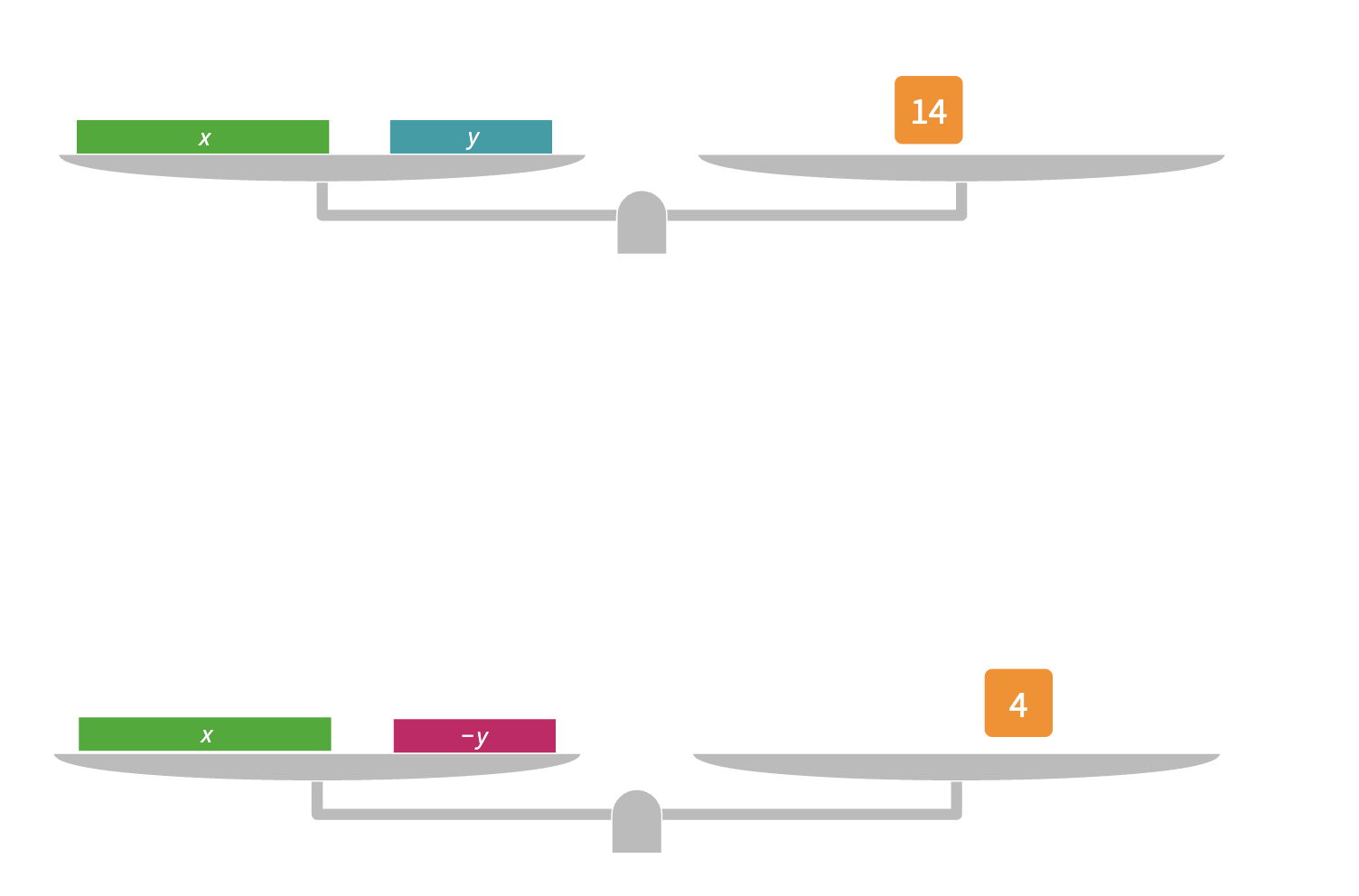
I've been lucky enough to work with a teacher of a Grade 10 Applied class and we have been trying to adopt a more visual approach to help students make sense of solving linear systems. We began by challenging students with this puzzle:
A Math(s) teacher from Yorkshire, now working in Ontario and always learning about how students best learn Math(s).
Wednesday, November 22, 2023
A Visual Approach to Solving Linear Systems by Elimination
Tuesday, May 9, 2023
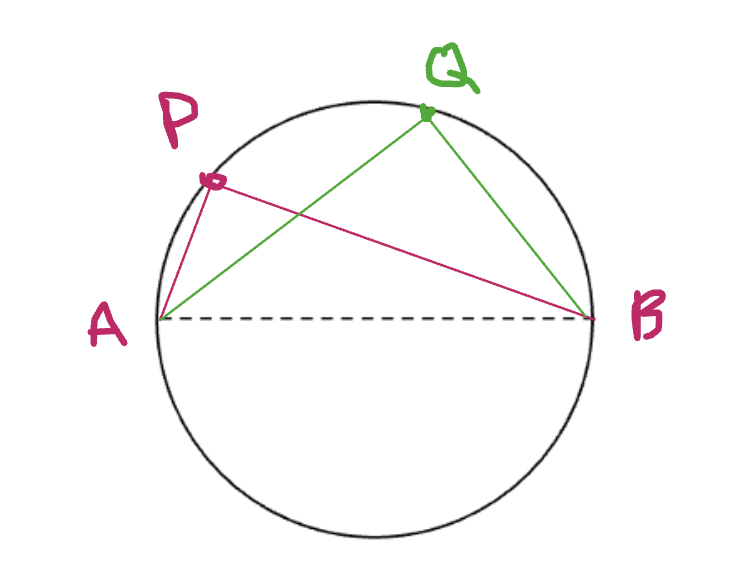
Developing Some Circle Properties
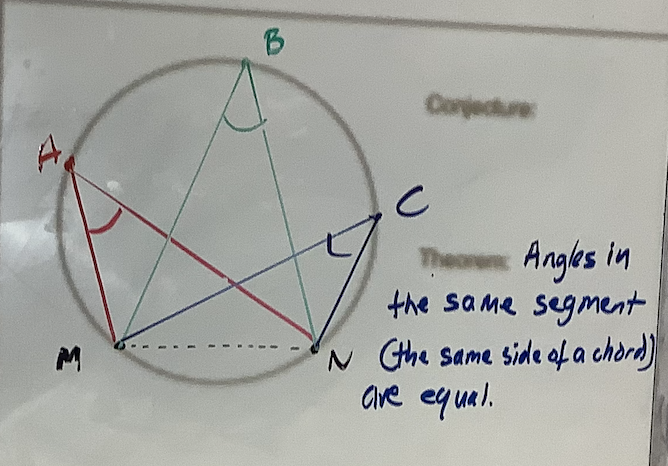
Recently I visited a class to help students develop these properties. My approach is to do so using the concrete-diagrammatic-symbolic continuum and to encourage students to make conjectures before we formally prove a particular property.
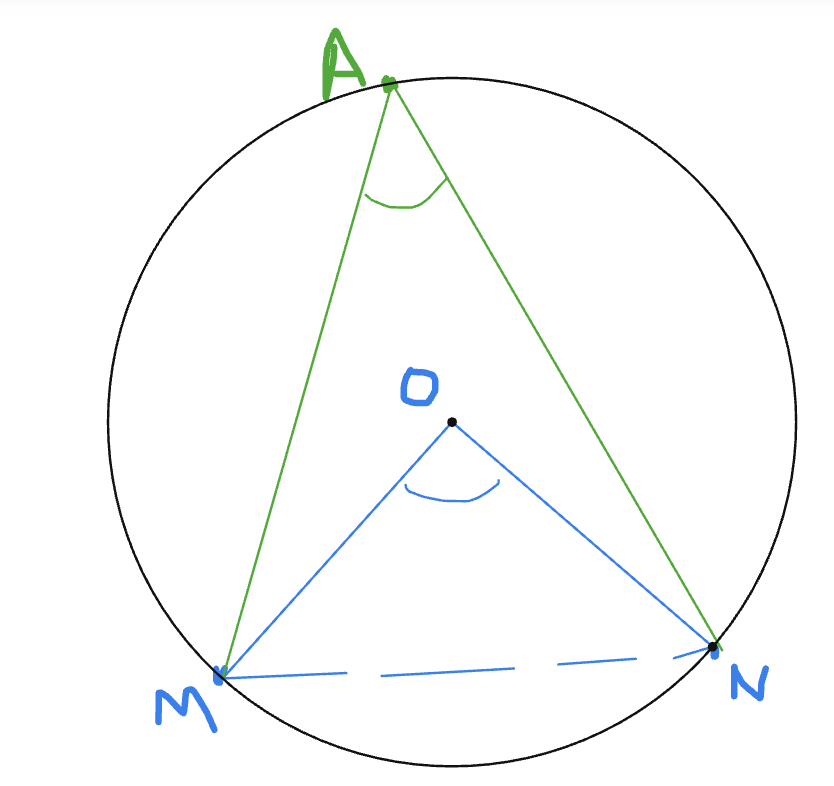
Again, this is not a proof per-se, so I then walk them through a visual proof as seen below. The key thing I emphasise here is that when you draw on radii in a circle, you can create isosceles triangles galore!
Friday, February 10, 2023
Incorporating Indigenous Ways of Knowing Into Math
I recently spent two thought-provoking days at the Ontario Mathematics Co-ordinators Association's annual conference. The theme was on how we can explore mathematics through Indigenous knowledge systems and our two featured speakers were Isaac Murdoch and Jodie Williams. As often is the case with these conferences, I left with a head overfull of new ideas and thoughts that I needed to order and condense so that I might have a better chance to actually incorporate my new learning. Three things in particular stood out for me:
Whether it was the Egyptians who needed to develop ways of measuring the agriculturally-rich land around the Nile fairly or the Polynesians who learned incredibly sophisticated ways of measuring astral movements and using these to navigate thousands of miles across the Pacific Ocean, so many areas of math originated from a need to understand the world around us. Isaac is a great story-teller and as I listened to his many experiences of learning off the land (navigating his way out of the bush, thinking for a long time about how he was to go about building a birchbark canoe, using the stars of the Plough to help in the design of a lodge), something suddenly dawned on me:
The land is a perfect place to develop and nurture curiosity. And curiosity (which I would think is a transferrable skill) is essential to mathematics.
When we immerse ourselves in the land, we begin to notice and wonder:
- why does moss tend to grow on one side of trees?
- why do the branches of some trees grow longer on one side?
- why do certain plants flourish on one side of my garden and not the other?
- is it true that the sun always sets in the west?
All these noticings and wonderings are a precursor to a desire to understand different relationships, or to help see patterns. These are important mathematical traits.
2) The Importance of Physical Objects
Isaac also shared the importance of story-telling and how certain physical objects are used as a powerful aide-memoire. For example, the beads that were intricately arranged to form a necklace also revealed a family tree. Similarly the carvings on Isaac's memory stick each had immense significance such that you could sense the memories flowing through him as he held it.
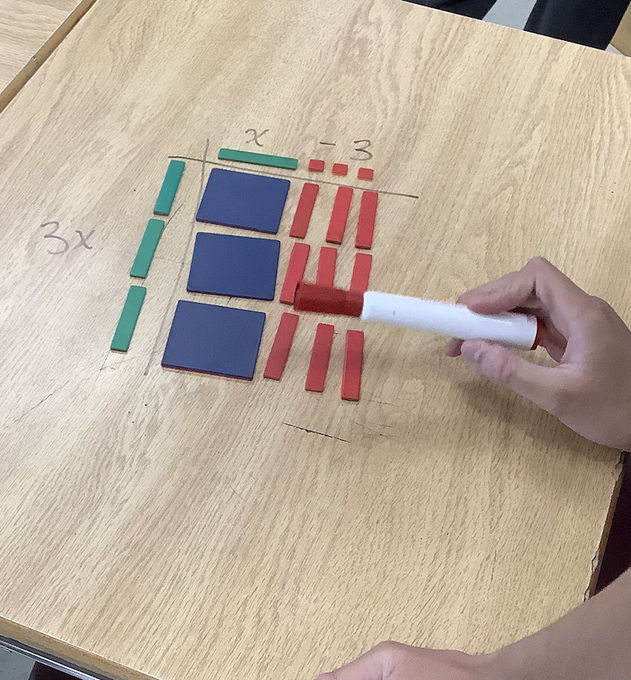
It got me thinking about the tactile nature of such objects and how these are an essential part of learning and understanding math. I have written many times about the importance of the Concrete-Diagrammatic-Symbolic continuum and how often in math, we do our students a disservice if we jump to symbolic without giving them enough concrete or diagrammatic experience. This was most recently made clear when I saw students make good use of algebra tiles to multiply binomials.
I wonder how much students have missed out on these concrete experiences (especially in Math) when they were learning online and how much they would benefit from it now.
3) The Importance of Incorporating Indigenous Knowledge Systems into our Pedagogy
One of the important changes to the new Grade 9 de-streamed math course is the inclusion of how math has historically developed across all cultures. Representation matters, and if our students can see how their culture helped in the development of Math, then they will be more likely to see themselves as mathematicians. Jodie explained how Indigenous knowledge systems are not about learning different math, but rethinking the way that we explore and demonstrate an understanding of the concepts: it's not what we teach but how we teach. In terms of re-thinking our pedagogy, Jodie encouraged us to think about how to make things more experiential. We could:
i) Start with an experience of doing
ii) Encourage students to share their learning as they experience the 'doing'
iii) Once students have become familiar with the experience, then teachers can bring in the math.
In many ways, I see similarities between these ideas and those of Peter Liljedahl's Thinking Classrooms. As such, I think that there are many math teachers here in Ontario who are walking down this path already. I also think that when we create lessons where, for example, we nudge students into developing a measurement formula, then we are also aligning with this pedagogy. My own personal experience is that this always leads to better learning.
I am grateful to OMCA for arranging this conference and to Isaac and Jodie for sharing their wisdom.
Monday, January 23, 2023
How Coding Revealed a Decimal Misconception
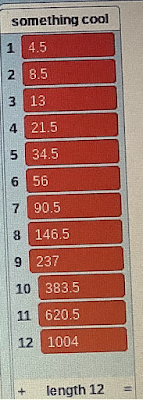
An interesting thing happened in a Grade 9 class recently. I was doing a coding activity looking at so-called Fibonacci numbers where students used a Scratch code to enter two initial values which then generated ten more values. The challenge was to get the twelfth term to be as close to 1000 as possible. I know that there is at least one solution that involves whole numbers but typically students get close to 1000 with two whole numbers and then use decimals to get closer and closer. One student tried 4.5 and 8.4 like this:
It was too low so she then tried 4.5 and 8.5:This was too big so she asked 'What do I do now?'
'Maybe pick a number between 8.4 and 8.5,' I suggested.
'But there are no more numbers between 8.4 and 8.5,' she replied.
As soon as she said this, I recognised a classic decimal misconception: sometimes students do not understand the density of numbers and that there are an infinite number of numbers between any two values. To help her rethink this, I drew a number line between 8.4 and 8.5 and asked her if she could now give me a value between these two:
'8.04... no, wait... 8.05,' she replied.Using some virtual manipulatives, I reminded her that since one-tenth is equivalent to ten-hundredths, and four-tenths is equivalent to forty-hundredths, then 8.4 and 8.5 are equivalent to 8.40 and 8.50 respectively:
As soon as I relabelled these on the number line, the light bulb went on.'Oh... I could try 8.45.... or 8.46 or 8.41!' This she did:
Now she was suddenly willing and able to use ever more precise decimals.
'So I could now try 8.455... and then 8.4555 and keep going like that?'
So this one coding activity did more to reveal and then help correct this particular misconception than anything that I can think of that I have used in the past and at the same time gave great insights into the density of numbers (a new expectation in Ontario's new MTH1W curriculum). This particular coding activity occurred towards the end of the semester though so what I am now thinking is that it should be moved more towards the start of the semester.
One other thing about this activity: I noticed that some pairs of values added to give a curious next value. For example, in the first case above, the seventh and eighth terms, 89.7 and 145.2, add to give 234.8999... and not 234.9. I think that this is because the two values that are inputted by the user are converted to hexadecimal values which are then added to give the next value as a hexadecimal. This is then converted back to decimal but there is sometimes a rounding error as can be seen
Friday, November 25, 2022
Algebraic Expressions and Polypad
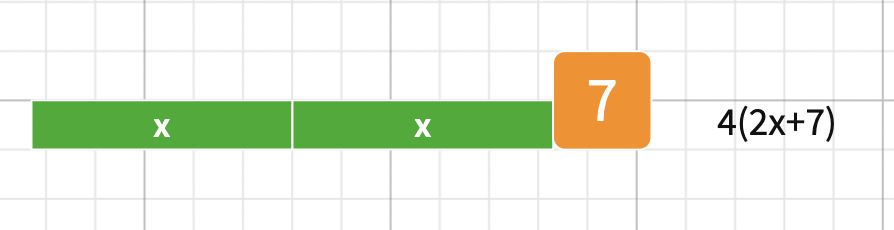
I tried this activity in Heather Lyon's MTH1W class using Polypad on Mathigon to help illustrate algebraic expressions. First Q: if this is x + 2 what would 3(x+2) look like? Students go to the VNPS to work in small groups:
Sunday, February 27, 2022
A Nice Algebra Puzzle
Last week I went into a Grade 9 class that had just begun to learn about simplifying polynomials by collecting like terms. I had an idea for a task that I thought would help them with this so began by showing them this pyramid.
I explained that the numbers in two adjacent squares add to give the number in the square directly above them. With this information, I split them into visibly random groups of 3 and had them work at whiteboards to find four numbers that go in the bottom row that would give 54 in the top square.By now, I could hear how adept the students were at collecting like terms and was impressed at the different ways they went about solving the task:
For the first problem, they did this by trial and improvement, so I walked them through how to set this up algebraically. I was pleased to see them al use this approach for the rectangle problem.