Showing posts with label Number Sense. Show all posts

Wednesday, November 5, 2025

The Sum of the First n Square Numbers

 One of the things I like to do as a teacher is provide visual proofs of why certain formulas work. A nice one that I use a lot in high school shows how to find the sum of the first n natural numbers:

I saw a method recently that shows a lovely visual approach to finding the sum of the first n square numbers and decided to share this with the students who come to our after school Math Contest Club. I use linking cubes to help me illustrate this.
First, I show them the sum of the first n square numbers and ask them to imagine that the last term is a general n by n square (and not a 3 by 3 square).

Then I make six copes of this sum:
Then I group them together: 
Then I get ready to put them together in two symmetric groups:
Then I join two of the sums together as shown to make an incomplete cuboid with a base of n by (n + 1):
Then I join the third sum to each of the blocks to create another incomplete cuboid with a height of (n+1):
Then I join these two blocks together to create a cuboid with dimensions n, (n+1) and (2n+1):

A simple division now allows me to get the sum of the first n square numbers:

This is a formula that I learnt to prove by induction but it is only when I have modelled it concretely that I fully understand why it works (especially the '2n+1' part and the '÷6' part).








Monday, May 27, 2024

Kaktovik Numerals

 In August 2021, I stumbled across the wonderful Katovik numeral system.

Kaktovik is a city in northern Alaska. In the 1990s, the students at a school in Kaktovik realised that there were problems matching Hindu-Arabic numerals to the patterns of their Iñupiaq language. As part of their math enrichment class, they set out to create new numerals that matched their language.

The Iñupiaq language of Alaska uses a Base-20 for its numerals with subdivisions for groups of 5. There are some rule breakers (looking at you, 6) and numbers before a multiple of 5 have a subtractive element '-utaiḷaq' included so 14 is a bit like saying 15 – 1.


The students devised a brilliant numeral system that matched their language (revealed below). I created and shared a task that teachers could use to get their students to learn about these wonderful numerals. This was originally meant to be a task for Grade 9s but today I tried it with two Grade 8 classes for the first time.
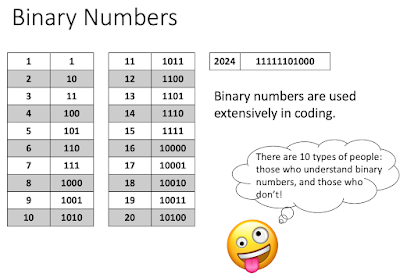
First, I showed them that they are already familiar withe different number systems that we use:

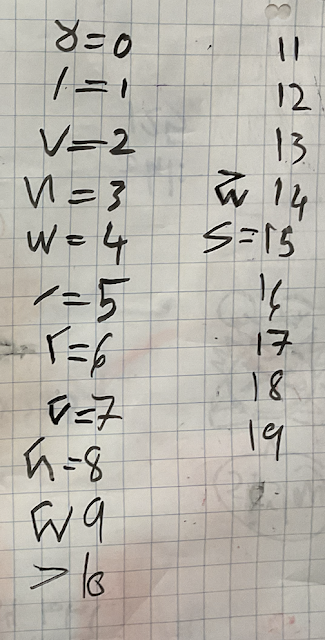
I told the students the story of how the students in Kaktovik wanted to create numerals that matched their language (as shown above) and then (after splitting the students into visibly random groups) I gave them the following clues and challenged them to find all twenty Kaktovik numerals:
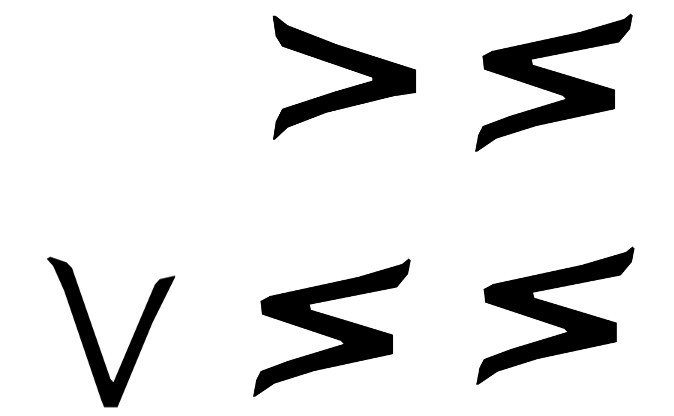
Immediately, all groups got stuck into the task. The first two clues were quickly deciphered to give the symbols for 1 and 2. These allow us to make sense of the third clue to find the symbol for 3 which can then be used in the fourth clue to find the symbol for 5. The next clue (which represents 4 + 4) helps us to get the symbol for 8:
At this point, I did remind some groups that there was a pattern behind the symbols that matched the Iñupiaq language. Once they understood that the symbols were not random, they began to make sense of the pattern to complete the numerals to ten. The sixth and seventh clues helped them fill in some other values for 14 and 15:
The penultimate clue was quickly deciphered by most groups to get the symbol for 0 which then allowed them to make sense of the last clue: 10 times by 2 equals 20. Using Kaktovik numerals, this is written as one group of twenty and zero ones. There was a lot of excitement in the room as students completed their work:
I then showed them how the place value columns in Base 20 differ to those in Base 10 i.e. to the left of the ones column, we have the twenties column and to the left of that we have the 20 squared (or four hundreds) column. I then challenged them to rewrite this Kaktovik numerals: 
This was definitely a challenge for some groups but I was pleased to see a lot of success with this.
Finally, I put up some 'Mild, Medium and Spicy' questions for them to try: 
This worked really well as students self-differentiated and all felt that they rose to the challenge:
There is now a Kaktovik numerals calculator app and I was able to show this to the students to check any given calculation. They really enjoyed seeing this!

I finished the lesson by making three important points:

  • There are pros and cons to any numeral system.
  • Don't assume that what you are familiar with is always the best way of doing things.
  • Anyone can create math that can have a positive impact on their community.

*            *            *

More information about the development of Kaktovik numerals and how they can be used to facilitate arithmetic operations can be found in this Scientific American article from April 2023.

UPDATE:

Some colleagues tried this in another Grade 8 class and saw this on one group's work!


Monday, January 23, 2023

How Coding Revealed a Decimal Misconception

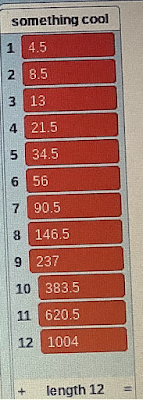
An interesting thing happened in a Grade 9 class recently. I was doing a coding activity looking at so-called Fibonacci numbers where students used a Scratch code to enter two initial values which then generated ten more values. The challenge was to get the twelfth term to be as close to 1000 as possible. I know that there is at least one solution that involves whole numbers but typically students get close to 1000 with two whole numbers and then use decimals to get closer and closer. One student tried 4.5 and 8.4 like this:

A table of values starting with 4.5 and 8.4 with each proceeding term being the sum of the previous two terms.
It was too low so she then tried 4.5 and 8.5:

A table of values starting with 4.5 and 8.5 with each proceeding term being the sum of the previous two terms.

This was too big so she asked 'What do I do now?' 

'Maybe pick a number between 8.4 and 8.5,' I suggested.

'But there are no more numbers between 8.4 and 8.5,' she replied.

As soon as she said this, I recognised a classic decimal misconception: sometimes students do not understand the density of numbers and that there are an infinite number of numbers between any two values. To help her rethink this, I drew a number line between 8.4 and 8.5 and asked her if she could now give me a value between these two:

A number line starting at 8.4 and ending at 8.5
'8.04... no, wait... 8.05,' she replied.

Using some virtual manipulatives, I reminded her that since one-tenth is equivalent to ten-hundredths, and four-tenths is equivalent to forty-hundredths, then 8.4 and 8.5 are equivalent to 8.40 and 8.50 respectively:

A number line starting at 8.40 and ending at 8.50
As soon as I relabelled these on the number line, the light bulb went on.

'Oh... I could try 8.45.... or 8.46 or 8.41!' This she did:

A table of values starting with 4.5 and 8.45 with each proceeding term being the sum of the previous two terms.

Now she was suddenly willing and able to use ever more precise decimals. 

'So I could now try 8.455... and then 8.4555 and keep going like that?'

So this one coding activity did more to reveal and then help correct this particular misconception than anything that I can think of that I have used in the past and at the same time gave great insights into the density of numbers (a new expectation in Ontario's new MTH1W curriculum). This particular coding activity occurred towards the end of the semester though so what I am now thinking is that it should be moved more towards the start of the semester.

One other thing about this activity: I noticed that some pairs of values added to give a curious next value. For example, in the first case above, the seventh and eighth terms, 89.7 and 145.2, add to give 234.8999... and not 234.9. I think that this is because the two values that are inputted by the user are converted to hexadecimal values which are then added to give the next value as a hexadecimal. This is then converted back to decimal but there is sometimes a rounding error as can be seen


Friday, November 25, 2022

Algebraic Expressions and Polypad

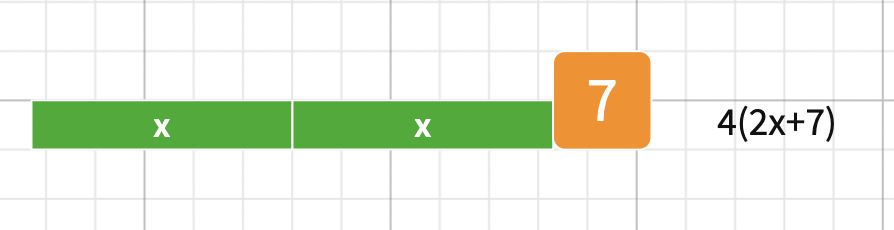
I tried this activity in Heather Lyon's MTH1W class using Polypad on Mathigon to help illustrate algebraic expressions. First Q: if this is x + 2 what would 3(x+2) look like? Students go to the VNPS to work in small groups:

Some puzzled looks at first but once they began sketching what it might look like, the students saw what was happening:


I could then easily use Polypad to confirm this:

I followed this up with 5(x+4) and we could now talk of more efficient ways of drawing our thinking. All the while I'm nudging them to the array model:

Now, I want to chunk the ones so give this question. Students' array models are now becoming more efficient:


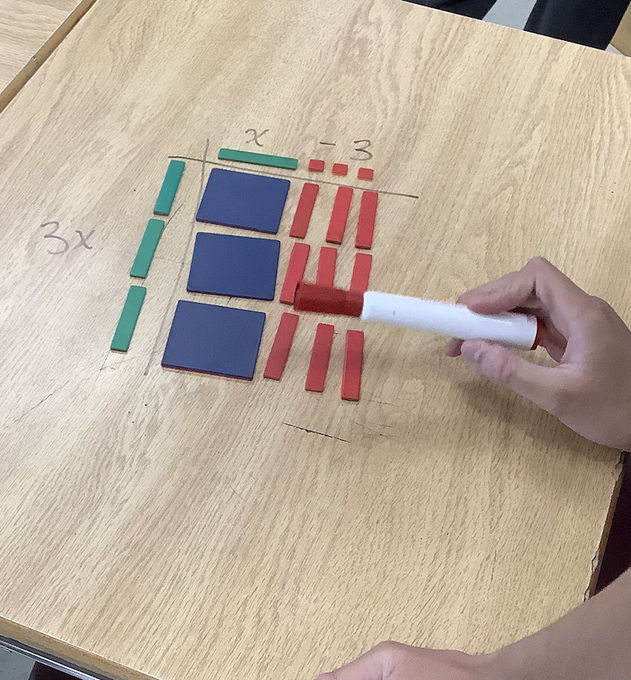
We do this for a few more example. As they are feeling confident, I want to push them so ask them to sketch out what x(2x+3) would look like. Though they have never seen this sort of question before, they connect it to the model that they have just been using:


I can quickly confirm this on Polypad:


Some students choose to use the concrete algebra tiles but I can then show them how this connects to the diagrammatic model. One of these students says 'Now I see it... and that will save time!'


A few more examples follow and while I help a couple of groups, I give an extension to others: the answer is 18x^2-27 x... what is the question? They factor this successfully without any help from me:


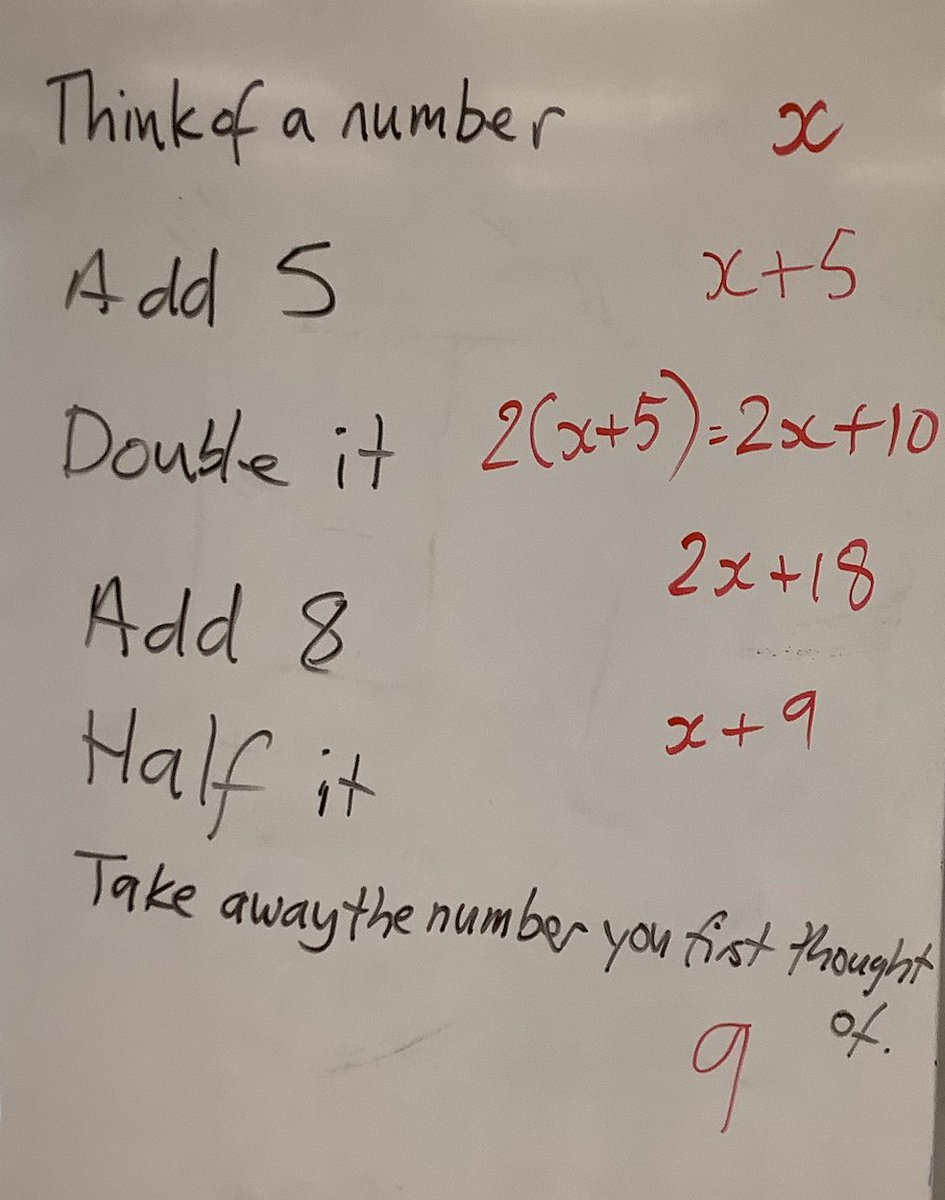
They have been working hard so we take a little break and I perform a little mathmagic: think of a number... add 5, double it... add 8... half it... take away the number you first thought of. By using a little chicanery with a pack of cars, I show them the nine of hearts... the number they were all left with!! I then show how I used algebra to 'rig the system'!


With a little bit of time left, we decide to see if they can use this new knowledge to solve equations. I scroll to the top of my polypad to create an equation from the first two expressions we created:


And with no fuss whatsoever, they successfully solve it!


I was thinking how this approach differed to the one I would have used when I began teaching. Then, I would have given ten examples, no visuals, all symbolic and got the students to do more exercises. Now the students (thanks to Mathigon!) are doing the math!
The link to the polypad I used is here.


Thursday, December 16, 2021

The 12 Days of Christmath: Day 12

 Here are the Day 12 puzzles for the 12 Days of Christmath challenge. Enjoy!!

Primary

Fill in the grid so that each row, each column and each  two-by-two square contains exactly one of each picture.


Primary (French)

Remplissez la grille pour que chaque rangée, chaque colonne et  chaque carré 2X2 contienne exactement une de chaque image.


Junior


Intermediate