Friday, April 26, 2013

Why We Need to Listen (1)

I (and pretty much most of my colleagues) have been raised in educational systems where your achievement was measured almost entirely through written products: quizzes, tests, exams. Sometimes these 'written' products were multiple choice tests and involved no writing at all to be evaluated. As teachers, this reliance on a written product is a hard habit to break; it is a habit which I have spent no small amount of time trying to justify to parents and students in the past. 
In the past few years, however, I have been completely deconstructing my original beliefs on how to evaluate students. If truth were to be told, I don't think I was ever truly comfortable with the way I was evaluating students. I often faced situations where I knew that students understood a particular concept but this wouldn't be reflected in what they wrote down. Or maybe I wasn't good enough to interpret what they were writing. Consider this question which I gave a Grade 8 class:
One morning, a cake shop bakes four hundred donuts. They sell two-fifths of these before lunch. They sell one-quarter of the remainder after lunch. How many donuts are left at the end of the day?
Now look at what this student wrote and ask yourself what grade you might give this (If you teach in Ontario, you might want to consider what level you would give this for Communication).
 
Now listen to what the student says when she explains her solution:

I have shown this to hundreds of educators across Ontario and the experience is always the same. Initially most people say that the student's thinking isn't clear. After listening to the explanation almost everyone agrees that the student does indeed explain her thinking clearly.
It stands to reason then that if we are not intentionally incorporating observations and conversations into our evaluations then our evaluation practices are ineffective.

Friday, April 19, 2013

What are the chances?

This past week I was in a couple of different Grade 6 classes doing some probability tasks. Watching the kids tackle these led to some huge insights as to what they actually are thinking when they do probability questions. It got us as teachers thinking if students make mistakes in a probability task, is the misconception to do with the concepts of chance or the concepts of number sense.
But the only way we could get these insights was by listening to the kids' conversations!
So here is the first question we tried, and the first misconception...
To be honest, you can see this student's point! The middle bag has a circle close to the top so that's the one to choose if you want to get a circle... just make sure you pick the top shape (especially if it  feels round!) This got me thinking that the question will be better if I use the same shape with different colours (e.g. just black and white circles). Anyway we addressed this misconception by putting some shapes in a bag and shaking them up and down and asking "Do you know where the shapes are now?" It did the trick!
The more common misconception though showed that the kids were thinking additively and not proportionally.
Essentially what this student (and some others) were saying was 'Since the first bag has the least number of squares, you are less likely to pick a square... therefore you are more likely to pick a circle.' Conversely, there were other students who picked the third bag as it had more circles. The interesting thing was that when we asked the students to write the probability of getting a circle they were good at this: most were able to say 2/5, 6/15, and 10/25. So they might have understood the chance of getting a circle but they misunderstood the concept of equivalence. We challenged these ideas by representing the fractions using a virtual manipulative:
It was clear that students will still need to see concrete representations of fractions for them to move from additive thinkers to proportional reasoners.
We then stumbled across another misconception; we asked students what will happen if they flip a coin. They wrote their answers on post-it notes which allowed us to quickly display the results:
 
Here, the majority of students don't clearly understand chance. Some students thought that if you begin with the heads 'up' then it will land heads 'up'! Of course, we tested these ideas straight away.
What was also apparent was that if students only ever experience situations in which all the possible outcomes are equally likely then they might that in every situation, every possible situation is equally likely. Here is the second question we tried (in a different class):


We know that some students have the misconception that as there are three outcomes (i.e. you could pick a green, a yellow, or a blue) each one is equally likely. Again, a quick experiment usually is enough to challenge such notions. Or, in this case, say (as my colleague Chad did) "How about we play a game; every time a yellow is drawn, you give me $10 and every time a blue is drawn, I give you $10." They don't usually want to put their money where their mouths are!
Students began by representing their ideas with tiles as shown:

They could even write the probabilities correctly:
 However they had the misconception that another yellow was being added, the probability was increasing. In other words they couldn't see that the original 4/8 probability was the same as the final 5/10 probability. We asked them to think of how they could use the tiles to convince us that in fact 5/10 was larger than 4/8 (rather than us show them that in fact they are equivalent). Light bulbs began to go on when they used representations such as these:
We also showed equivalence using the virtual manipulatives above for further proof (always a good thing).
 
So for students to experience success in probability we concluded that they must have the opportunity to use represent it in a variety of ways (e.g. spinners, tiles, number lines etc.) The nlvm site has a superb applet for spinners by the way in which you can design your own spinner and have it spun for up to a thousand spins and have the results displayed in a live bar graph.. Here is one such bar graph which begs the question 'What did the spinner look like?'
But we also wondered if students would also improve their understanding of probability by playing board games, card games, and dice games like Yahtzee. Maybe this could be the perfect homework assignment!


Wednesday, April 10, 2013

"We're Into the Third and Final Quarter..."

So once said a sports commentator on British TV. Yogi Berra (the famous New York Yankees catcher) once was asked if he preferred his pizza cut into four pieces or eight. He replied, four as eight pieces would be too many! Fractional misconceptions are everywhere as seen in this advert:
The chart above actually gets my vote for The Most Pointless Legend Ever (look closely at the bottom left-hand corner).
As I and my colleagues bounced ideas off each other as to why fractions are so problematic, it became clear that what worried us most was that students might not have a concrete grasp of the basics of fractions. That maybe when we teach fractions we rush too quickly to procedures and algorithms (and end up saying things like "'reduce' this fraction" or "there's no need to wonder why, just invert and multiply").
So our line of inquiry going into a Grade 2/3 class was based on these two wonderings:
Do the students really understand fractional names?
What is the best way of getting students to work with these fractional names?

We showed the following screen to students and asked them to discuss in pairs where the labels should go:
 
Good class dialogue led to some consensus:


But when they reached the last label there were more than a few puzzled looks:
Some students wanted to put the fourths label on the last circle simply because it was the only one without a label. Others argued that the last circle was in fact split into fourths, in fact there were three fourths:
This puzzled me at first until I realised that what the student saw was three fours and not three fourths.
So to address this we tried to connect it to the language of fifths, sixths, eights and tenths. By getting them to see the pattern that five fifths make a whole as do six sixths, eight eighths and ten tenths, then you must need four fourths to make a whole. They then realised that the fourths label would go on the same circle as the quarters label. Of course the language of thirds and halves (why halves and not twoths?) doesn't make this linguistic pattern easier to spot: sometimes the English language gets in the of learning Math. All of this certainly challenged any notions that we might have had that these students all knew how to label fractions; to assume otherwise will lead to a host of problems. 

We then gave the students this Yogi Berra-inspired problem:
Would you  prefer five half-pizzas or nine quarter-pizzas?
We were able to give three pairs of students iPads and they used an app called Virtual Manipulatives. It was noticeable how much easier this made it for these students to model and communicate their thinking:
Other students relying on pencil and paper sometimes struggled to see how to compare the two quantities and some were still stuck on the idea that nine pieces must be better than five pieces:

There was also one pair who drew five pizzas split in halves and nine pizzas split in quarters: they had misinterpreted what five half-pizzas and nine quarter-pizzas meant. I wonder how many other students make this error?

All of us left realising that students need a wealth of concrete experience with fractions, much more than they are probably currently getting. We also agreed that this experience shouldn't just be confined to a two-week unit; it is something that should be experienced across (and even beyond) the Math curriculum throughout the year.

Fraction immersion, as it where.

A word of caution though: learning about fractions involves so much more than the 'pizza' fractions seen above. Here fractions are being used to describe an area, but fractions can also be used to describe a set (in a class of 13 girls and 15 boys, what fraction are girls?) and fractions can be used as a number (what number is halfway between three-quarters and two?) Students must  experience fractions in each of these situations.

Monday, March 25, 2013

Which Cow Gets Most Grass?

Here is a little activity that I've used in a number of classes that has always given us great information about what the students do and don't know about number sense and area. It starts with the question below. Note that I go to great lengths not to use the word area at any point.
 
 
Most students work on somehow counting the squares inside each 'pen'. Occasionally. some students will make the mistake of finding the perimeter of each pen. Usually I get them to reflect on this error by asking "Can you shade the grass that the cow is going to eat?"
Sometimes they interpret the question as "Which cow has eaten the most grass (in the past)?" and will respond like this:
Other times, students will try a 'count-all' approach and sometimes will not include the area udderneath the cow.

Here, I remind the students that the cow can move around which usually is enough to get them to realise to include the missing area.
But I really want them to move away from this 'count-all' approach. I want them to see that there are more efficient ways of finding the area and have thus chosen the dimensions of the pens quite deliberately. When I chat to the students I often find that they know that counting all is time-consuming and prone to error. Now the students I was working recently with were grade 3s and there was certainly now way that I was going to chuck a 'just do length times width' at them. However, we consolidated a few of their strategies and this is what we got:


Here, the student split the pen into a 10 by 6 pen and 1 by 6 pen. The area of the former is 60 and the extra 6 of the latter gives a total of 66. Neat, eh? Now look at what this student did and wrote and try to figure out what they 'saw'.
I don't know about you, but I'm quite impressed that a grade 3 student is comfortable writing
12×5+6 and this gives a clue to what they saw: there are 12 squares in the top two rows of the pen and there are five such rows (hence 12×5) with the extra 6 on the bottom row being added at the end. This student actually counted by 12s too ("12, 24, 36, 48, 60!")
This student more clearly split the pen into equal sections of 8 to get the total area. In fact looking at the three examples above it is clear to me now that the ability to decompose the pen into smaller pens is a really important strategy (the same way that we sometimes decompose numbers into smaller numbers in order to make calculations easier).
But it is also so powerful that students (and teachers) see these different approaches as it does help expose inconsistencies and misconceptions. All these strategies are solidifying their multiplicative understanding and preparing the groundwork that will allow them to develop the formula for the area of a rectangle.
Finally, listen to this student's reasoning:
Again, I love my job!


Wednesday, March 20, 2013

How a Question Evolved

Some of the math problems I give kids (and adults) have been begged, borrowed and stolen from many unsuspecting folk. Other questions however, I have created and developed by myself or with colleagues. It strikes me that this is an important skill yet it is one which I don't recall ever learning about in teachers' college. And part of the skill in developing a question is being able to reflect after the fact if the said question actually got the kids to learn what you hope they would.

So I was in a Grade 4 class before March Break and the teacher was just beginning to start a unit on division. In Ontario, this involves solving 2-digit divided by 1-digit problems. We wanted to create a question with a context so that students would be forced to consider any remainders and what they might do with them. Our first suggestion was:
A large pizza has eight slices. If 40 pieces of pepperoni are used, how many pepperoni pieces would be on each slice?
We quickly dismissed this as a) There are no remainders to think about and b) is pepperoni ever distributed evenly anyway?
The next suggestion was:
I pay $47 for five hats. How much is it per hat?
Whilst this does have a remainder to deal with we wondered if this would be a question that students would engage in. And, of course, why would you buy five hats anyway?!
The classroom teacher then mentioned that there were 19 students in her class and that they liked going to Canada's Wonderland. That got us thinking:
If a roller coaster car holds 4 people, how many cars would be needed for the whole class?
What if the whole school went? How many many roller coaster cars would be needed?
Then, because we realised that there are height restrictions for these rides:
If a roller coaster car holds 4 people, how many cars would be needed for 93 kids?
Someone mused "I wonder how long they'd have to wait to all get on?" and the question then evolved again:
There are 93 people waiting in line for a roller coaster. Each roller coaster car hold four people and there are 6 cars to a 'train'. There are five minutes between each roller coaster train. How long will the person at the end of the line have to wait before they go on the ride?
We were very pleased with our brilliant efforts and, after we had opened the champagne, even found a video of people lining up for a ride just as a 'train' leaves which we used as our Minds On.
However, as the kids began working on the question we noticed something that was quite glaring: they weren't using division as a strategy. Most student realised that there were 24 people on each train so they either counted up by 24s till they got to 93 or counted back by 24s from 93 till they got to zero. There was also a five-minute discrepancy in the times they worked out but this was because some kids thought that at time t=0, a train takes the first 24 away while others thought that at time t=0, a train has just left without the first 24. The students were able to justify this though either way so we were OK with this ambiguity.
Our group went back to the library to talk about what we saw. We had thought that we had developed a brilliant division question. We were wrong. It was a great problem solving question for sure and the kids were engaged in solving it. But, no division was evident.
So we followed the advice we often give our students:
We tried, we made a mistake, we learned from it, we moved on.
So we came up with two other questions that would allow us to be more intentional about division:
a) There are 74 students in Grade 4 and they will be split into 4 tchoukball teams. How many will be on each team?
b) There are 74 students in Grade 4 and they will be split into curling teams with 4 to a team. How many teams will there be?
The first question is a sharing problem whilst the second is a grouping problem and student need to experience both of these types of division.
A couple of students solved it like this:
 
... but they admitted it was difficult to keep track of the numbers.
One student kept a running total like this:
...but again felt that it was a pain drawing a tally for each of the 74 children.
One student used her multiplication table to help figure the answer out:
Neat eh?
Others set their work out like so:
What was powerful was that when students who used one of the first two methods above got to see other ways of solving the question they really liked the last way as it was much more efficient. Yet no matter what method was used we were able to show the students that what they had all done was in effect 74 ÷ 4. In other words, this question actually got the students to think about division, something our first question failed to do.


Thursday, February 14, 2013

I ♥ Arrays

Arrays are brilliant.
I'll say that again.
Arrays are brilliant. I love the fact that I can talk about them in a kindergarten class as well as in a Grade 12 class. Arrays allow me as a teacher to help students connect ideas and concepts especially when it comes to multiplicative thinking. Yet I had no real experience of arrays at school but I wish I did; it would have given me a much deeper understanding of some important algebraic concepts.
 
So I was in a Grade 5 class this week. The teacher has been working very hard to address any gaps in the students' additive thinking and was now pretty sure that they were ready for some work on multiplication We wanted to see how they would solve a fairly routine equal groups problem so gave them the following:

A baking tray holds 15 donuts. How many donuts would there be on 13 trays?
 
Now one or two attempted to use an algorithm but were making lots of procedural errors:
Others relied on sketching out the problem:
In the case above the thirteen trays drawn have 10 donuts giving 130. The student then reasoned that the remaining five donuts per tray would give another 65 thus giving 195 in total.
Others used some really neat student-generated procedures:

What was important was that the students sensed that they had to do 15×13. They had also done some work using arrays to represent 6×5, 4×3 etc. So I said that suppose we had to do 16×11 then we would get an array like:
 
By splitting the 16 and 11 into a friendlier 10 and 6, and 10 and 1 the students were able to tell me quickly how much was in each of the four quadrants:
... and from there tell me that the answer was 176 (some added in their head, others wrote their work on paper). We then returned to the donuts question to see how we could use the array to help us here but I pointed out that I didn't want to draw out all the donuts as it would be too time-consuming!
"Wow, that's so much quicker," said one student and many agreed. We consolidated by trying another problem (essentially 17×15) and here is a sample of work:

I love the way that there are no place value lies in this method and that it encourages good number sense. I have seen some students develop this array method into a partial products method:


...which is neat but to me what is even neater is when I can use the array method to explain what happens when you multiply polynomials. When I first came to Canada I learned a new acronym: FOIL. I found a lot of students misunderstood this (it stands for First, Outside, Inside, Last) but they had much greater success when they drew an array:
And when there are more terms in the polynomials it becomes easier to collect the like terms as they lie on the diagonals:
I have shared this method with parents at Math Evenings and it is always neat to see their faces when I give these examples: they finally understand why it works!
I could go on about how arrays make it easier to understand what it means to 'complete the square' or how they can be used to do polynomial division (see James Tanton's excellent video on this).
But for today, it was rewarding to see how quickly the students took to this method and how it fitted in so nicely with their existing knowledge.

Thursday, January 31, 2013

Now That's What I Call Feedback

I am slowly but surely working my way through James Joyce's Ulysses (my goal is to finish reading it before the summer!). I find the whole stream-of-consciousness technique fascinating (if at times confusing). Today I was in a Grade 6 class and I was suddenly reminded of Ulysses when we used TodaysMeet and saw the stream-of-consciousness of the students.
The students had been working on probability so we asked them this question:

In this can, there are between 10 and 30 cubes. A third of them are blue. What could be in the can?

This is what was in the can:
What followed blew us away. The class had a set of iPads and the students began posting their solutions immediately.
Or their questions.
Or their revised solutions.
Or advice for other students.
Or requests for help.
As a teacher I could see who needed help just be looking at the feed on TodaysMeet. This stream-of-consciousness eventually ran to over 27 pages! Below is just a sample of what was going on. As you read through it, see if you can link all the conversations.


 Isn't all that feedback just wonderful? It was fantastic to see students not being afraid to say if they are stuck and ask questions and other students helping them and sharing ideas. At this point we gave them some additional info. We told them that there were just two colours, blue and green, and that there were between 10 and 20 cubes (not 10 and 30). This really caused problems for some students:


Yes, some students did get stuck but there was so much feedback available that they overcame these difficulties:


Some used blocks to help their thinking:

At this point we asked the class for all the possible solutions. They told us that you could have A) 4 blue and 8 green, B) 5 blue and 10 green, or C) 6 blue and 12 green. What really pleased us is how they were able to reason why these were the only possible solutions (e.g. because these are the only totals between 10 and 20 that are multiples of 3). 
We then gave them one final piece of info: the total number of  cubes was odd. They then had to vote on what was in the can based on A, B, or C as detailed above:

We were pretty chuffed to see someone reason so clearly here!
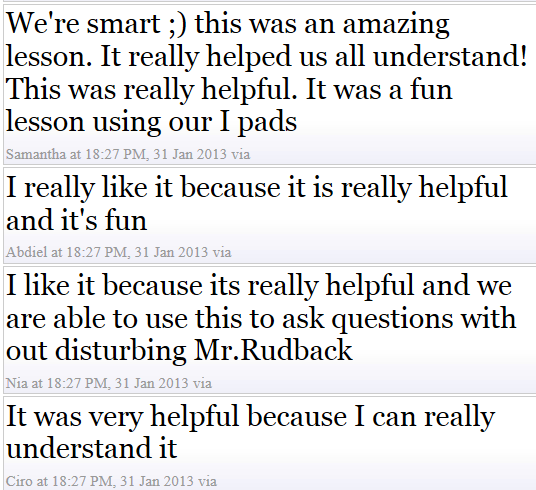
At this point we wanted to know what students thought of the whole experience. Dave, the classroom teacher, reminded them that we were looking for descriptive feedback. This is what we got. Then picture the smiles on our faces.


So if this the richness in thinking that is potentially there, can you imagine what a disservice is done when students are asked to simply copy a note? In silence?
The final say goes to this student who summed up how we all felt today:
Hooray indeed.
                                    *                                           *                                           *
TodaysMeet can be found here: http://todaysmeet.com/